Irom Sharmila - The Iron Lady of Manipur
For sixteen long years, Irom Chanu Sharmila embodied the struggle for human rights in Northeast India. Her fast, which began in November 2000, was not just a personal vow but a powerful, non-violent political weapon aimed at dismantling a single piece of legislation: the Armed Forces (Special Powers) Act, 1958 (AFSPA). This article delves into the extraordinary life of the woman dubbed the ‘Iron Lady of Manipur,’ tracing the roots of her protest, the excruciating details of her confinement, the global resonance of her sacrifice, and the complex legacy she continues to shape in the region's tumultuous political landscape.
The Malom Massacre and the Dawn of the Fast
The story of Irom Sharmila’s unwavering resolve begins on a bloody morning that ripped through the quiet normalcy of Imphal, the capital of Manipur.
November 2, 2000 - The Bloody Morning at Malom
On November 2, 2000, a routine bus stop in Malom, a small town in the Imphal Valley, became the site of a horrific tragedy. At approximately 8:30 AM, ten innocent civilians were allegedly gunned down by personnel from the Assam Rifles, a paramilitary force operating under the cover of AFSPA. The victims were ordinary citizens going about their daily lives - a devastating mix of vulnerability and promise:
A 62-year-old woman, Leisangbi Devi, on her way to a local temple.
An 18-year-old boy, Sinam Chandramani, who had recently won the National Bravery Award.
A pregnant woman.
Seven other unarmed individuals.
The official narrative claimed the security forces were responding to an attack by insurgents. However, eyewitness accounts vehemently rejected this, stating the firing was indiscriminate and unprovoked. The Malom Massacre, as it came to be known, exposed the brutal reality of a state saturated by militarization and operating under a blanket of immunity. For many, it was the final, unbearable straw.
The Vow of Silence and Sacrifice
Just three days later, on November 5, 2000, 28-year-old Irom Chanu Sharmila, a soft-spoken poet who had previously expressed her pain through verses, sat down near the site of the carnage. She made a solemn public declaration: "I will not eat, drink, comb my hair, or look into a mirror until the Armed Forces (Special Powers) Act is repealed."
This was not a fleeting protest; it was a commitment to a slow, methodical self-destruction for a political cause. Her fast lasted for 5,800 days - exactly 16 years, earning her recognition in the Guinness Book of World Records and the Limca Book of Records as the world's longest political hunger strike. It was an unparalleled display of Gandhian Satyagraha in the modern age, transforming her frail body into the most potent symbol of resistance against state brutality.
Understanding AFSPA - The Instrument of Impunity
To appreciate the depth of Sharmila’s sacrifice, one must grasp the nature of the law she challenged. AFSPA, enacted in 1958, is widely considered the most controversial piece of legislation in modern Indian democracy.
Legislative Overreach and Draconian Powers
The Act grants extraordinary powers to the armed forces operating in areas designated by the central government as “disturbed.” The core provisions of the Act are starkly antithetical to constitutional guarantees of life and liberty:
Section 4(a): Power to Shoot to Kill: Any commissioned officer, warrant officer, or non-commissioned officer may fire upon or use force, even to the extent of causing death, against any person acting in contravention of laws prohibiting assembly or the carrying of weapons. This power is exercised purely on “reasonable suspicion.”
Section 4(c): Arrest without Warrant: Security forces can arrest anyone without a warrant and use necessary force to effect the arrest.
Section 5: Search and Seizure: Forces can enter and search any premises without a warrant.
The Shield of Impunity
The most egregious aspect of AFSPA, and the primary target of Sharmila’s fast, is Section 6, which mandates that no prosecution, suit, or legal proceeding can be instituted against any member of the armed forces for actions taken under the Act, except with the prior sanction of the Central Government.
This effectively grants soldiers a license to kill and commit other human rights violations without fear of civilian prosecution. The impunity created a climate of terror and fear, leading to thousands of alleged extrajudicial killings, rapes, and enforced disappearances. The highly publicized 2004 case of Thangjam Manorama, who was allegedly raped and killed by Assam Rifles personnel, fueled massive protests, including the defiant stripping of 12 elderly women outside the Assam Rifles headquarters, and further highlighted the moral bankruptcy fostered by the Act.
The Prison of the Body - How Sharmila Survived the Fast
Sharmila’s 16-year fast was not a continuous choice but a continuous resistance to the state’s relentless effort to keep her alive against her will.
Arrest and the ‘Attempt to Suicide’ Charge
Three days after starting her fast, Sharmila was arrested by the Manipur Police under Section 309 of the Indian Penal Code (IPC)—Attempt to Commit Suicide, a provision that criminalized the act of ending one’s own life. Since the maximum punishment under this section was one year in jail, the state established a relentless cycle: she would be released after 364 days, only to be rearrested the very next day for resuming her fast, thus continuing her confinement indefinitely. She was lodged in the security ward of the Jawaharlal Nehru Institute of Medical Sciences (JNIMS) hospital in Imphal, a space she poignantly referred to as her "prison."
The Torture of Force-Feeding
To keep her alive and negate the political impact of her impending death, the government subjected Sharmila to daily, agonizing force-feeding. Three times a day, a nasogastric tube (Ryles Tube) was forcibly inserted through her nose and down into her stomach. Through this tube, a mixture of liquid nourishment—milk, glucose, fruit juices, and protein powder—was delivered.
She received an average of 1,800 to 2,200 calories and 1.5 to 2 liters of fluid daily. The process was physically brutal, often leading to bleeding from her nose and throat. Medically, her body endured severe stress: her weight dropped significantly, her teeth enamel deteriorated, and she faced risks of osteoporosis and hormonal imbalance.
Sharmila often described this process not as "eating" but as being "fed" by the government, emphasizing that the fast remained unbroken by her will. She refused to comb her hair, brush her teeth, or look in a mirror, maintaining her vow of personal sacrifice. These deliberate acts of self-deprivation underscored the depth of her moral protest.
A Political Demand, Not Suicide
Crucially, the legal grounds for her detention were repeatedly challenged. In several rulings, notably one by the Manipur East Sessions Court in 2014, the judiciary recognized her fast as a “political demand through lawful means” and not a genuine intent to commit suicide. Despite these rulings ordering her release, the state would promptly re-arrest her, illustrating the deep entanglement of legal procedures and political expediency aimed at silencing her protest.
Global Recognition and Moral Authority
Irom Sharmila’s solitary struggle transcended the borders of Manipur, elevating her to the status of a global human rights icon.
The Voice of Conscience
Her unwavering commitment earned her the moniker ‘The Iron Lady of Manipur.’ Internationally, she was called ‘Mengoubi,’ or ‘The Fair One,’ by her people, symbolizing her purity of purpose.
Amnesty International declared her a “Prisoner of Conscience” in 2010, recognizing that she was detained solely for the peaceful expression of her deeply held beliefs.
She received major international accolades, including the Gwangju Prize for Human Rights (South Korea, 2007) and the Rabindranath Tagore Peace Prize (2009).
In 2013, she was nominated for the Nobel Peace Prize, solidifying her position alongside icons of non-violent resistance.
Judicial and Official Scrutiny of AFSPA
Sharmila's moral pressure forced the Indian government and judiciary to confront the atrocities committed under AFSPA.
Jeevan Reddy Committee (2005): Following widespread agitation after the Manorama case, the government appointed the Justice Jeevan Reddy Committee to review AFSPA. The committee unequivocally recommended the repeal of the Act, terming it “a symbol of oppression” and suggesting its replacement with more humane provisions within the Unlawful Activities (Prevention) Act.
Santosh Hegde Commission: A commission appointed by the Supreme Court to investigate six cases of extrajudicial killings in Manipur also criticized the Act, agreeing that it had become “an instrument of discrimination and high-handedness.”
Supreme Court Verdict (2016): Just before Sharmila ended her fast, the Supreme Court delivered a landmark ruling, asserting that the armed forces cannot use “excessive and retaliatory force” in disturbed areas and mandated comprehensive police inquiries into alleged extrajudicial killings, effectively questioning the blanket impunity provided by Section 6 of AFSPA.
The Political Shift and Electoral Defeat
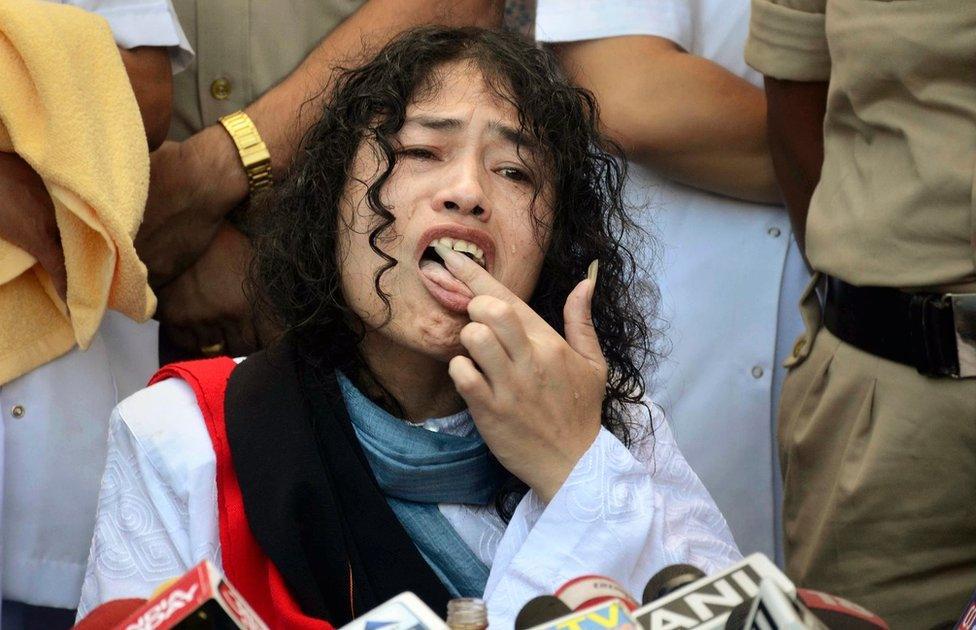
On August 9, 2016, Irom Sharmila broke her historic fast by licking a spoonful of honey, a move that stunned her supporters and drew criticism from segments of the community she fought for.
Breaking the Fast - A Strategic Retreat
Sharmila announced her decision to end the fast because she realized that her prolonged sacrifice had not achieved the desired political outcome—the repeal of AFSPA. She decided to exchange the weapon of non-violent fasting for the tools of democratic politics. She declared, “I have been fasting for the last 16 years. I haven't got anything from it yet. I am ending my fast today. I want to try a different agitation now.” Her goal was clear: to become the Chief Minister of Manipur and repeal AFSPA from within the system.
The Crushing Defeat
She founded a political party, the People’s Resurgence and Justice Alliance (PRJA), and contested the 2017 Manipur Legislative Assembly elections from the Thoubal constituency, running against the then-Chief Minister, Okram Ibobi Singh.
The outcome was a devastating symbol of the chasm between idealism and electoral reality: she secured only 90 votes. The former Chief Minister won by a landslide.
This dramatic loss highlighted a crucial socio-political reality: while Sharmila was revered as a powerful moral symbol, the public struggled to view her as a viable political leader capable of navigating the complex, often corrupt, world of electoral politics. Her failure was a lesson in the fragility of symbolic resistance when translated into institutional power. She later reflected, “I haven’t failed, I have learned.” The political experiment, though short-lived, underscored the immense difficulty of fighting a deeply entrenched system from within.
The Enduring Legacy - Motherhood and Renewed Activism
Following her political defeat and subsequent retreat from active electoral life, Sharmila relocated and began a new chapter, but her commitment to Manipur’s future remains firm.
Life in Chennai and the Autobiography
Irom Sharmila married her long-time partner, Desmond Coutinho, a British citizen, and settled in Chennai. In 2019, she gave birth to twin daughters, whom she named Nix Sharmila and Autumn Sharmila. Her shift from the ascetic life of a political prisoner to the role of a mother marked a profound personal transition.
She channeled this transformation into her writing, publishing the autobiography "Iron Lady No More" (expected around 2024/2025), a title that encapsulates her new identity. She states, "I am no longer the Iron Lady; I am now a mother." This change, however, did not signify an end to her commitment to justice.
Standing Tall During the 2023 Manipur Crisis
The outbreak of the devastating ethnic conflict in Manipur in May 2023 drew Sharmila back into the national spotlight, albeit from afar. She spoke out fiercely, criticizing both the state government under Chief Minister N. Biren Singh for its inability to maintain peace and the silence of Prime Minister Narendra Modi.
Calls for Intervention: She appealed directly to the Prime Minister to intervene decisively, stating that the central government was "responsible" for allowing the crisis to spiral out of control.
Critique of Governance: She argued that the imposition of President's Rule was not a genuine solution but merely an evasion of democratic accountability.
A Call for Unity: In a suggestion rooted in Manipur's historical identity, she proposed that the titular King of Manipur be invited to serve as a symbolic figurehead of unity, similar to a governor, to bridge the ethnic divide between the Meitei and Kuki-Zo communities.
Her statements during the crisis reaffirmed that the fight for peace and justice, for which she sacrificed 16 years, continues to define her public life.
The Current Status of AFSPA - Is the Fight Over?
Despite Sharmila’s immense sacrifice, AFSPA is not yet fully repealed, but her efforts have catalyzed significant changes.
Progress and Partial Repeal
The 16-year fast put sustained pressure on the central government, leading to gradual, albeit cautious, steps toward the law's withdrawal:
2015: AFSPA was fully withdrawn from Tripura.
2022: The Central Government initiated a phased reduction, withdrawing AFSPA completely from various districts and police station areas in Assam, Nagaland, and Manipur.
2024/2025: AFSPA remains in force in certain vulnerable and strategically sensitive parts of Manipur, but it has been removed from a significant number of police station jurisdictions within the Imphal Valley, the heart of Sharmila’s protest.
The Setback of Violence
The progress is often tenuous. The eruption of the 2023 ethnic violence between the Meiteis and Kuki-Zo tribes led to a massive deployment of central forces. While AFSPA was not immediately reimposed across the entire state, the violence underscored the persistent instability that the government uses to justify the Act’s retention. Sharmila’s struggle demonstrated that militarization alone cannot solve a deeply political and social crisis.
The Power of One Will
Irom Sharmila’s story is a compelling chapter in the history of global non-violent resistance. She endured more than 5,800 days of forced feeding and confinement, turning her body into a living monument against a state law that sanctioned impunity.
Her life teaches us that:
Moral Victory Precedes Political Victory: While she lost the election, she won the moral battle, forcing judicial commissions and the Supreme Court to scrutinize the AFSPA.
The Power of Perseverance: Her struggle demonstrated that consistent, non-violent protest, even when met with state coercion, can ultimately alter the political landscape and chip away at seemingly invincible laws.
The Fight is Systemic: Her shift from the fast to politics, and her subsequent failure, highlighted the immense challenge of transitioning from being a revered icon of protest to an effective institutional change-maker.
Irom Sharmila is no longer fasting, nor does she claim the title of the Iron Lady. But the powerful seed of non-violence she planted on the blood-soaked soil of Malom continues to bear fruit. The memory of the ten people killed that day is not just one of sorrow but of immense courage, embodied by the young poet who chose sacrifice over silence. Her fight, though dramatically altered in method, remains an unfinished symphony for human rights and democracy in India’s turbulent Northeast.